
Why We Forget: The Neuroscience of Memory and Learning
Discover why we forget and how the brain learns—unravel the neuroscience behind memory loss and retention.
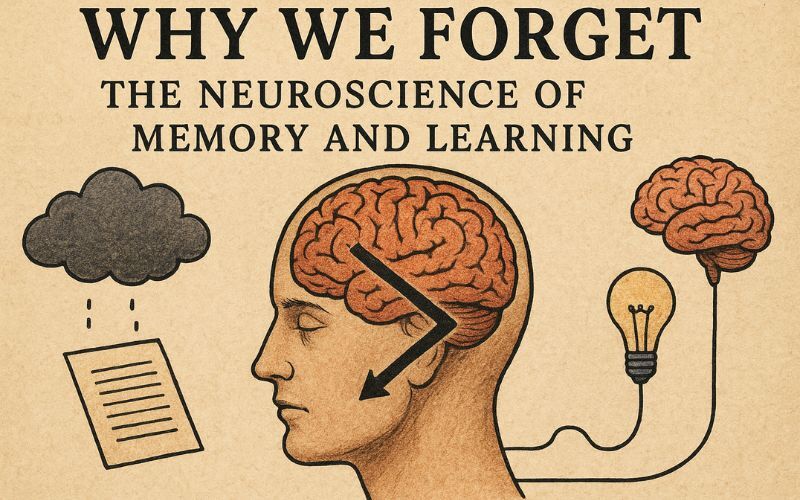
Have you ever walked into a room and completely forgotten why you went there? Or studied all night for an exam only to blank out on test day? Forgetting is one of the most universal human experiences—and, surprisingly, it’s not always a bad thing.
Neuroscience reveals that forgetting isn’t just a flaw in our brain’s design—it’s an essential part of how we learn, adapt, and survive. Understanding why we forget can help us improve memory, reduce stress, and make learning far more effective.
How Memory Works: A Quick Brain Tour
Before we can understand forgetting, we need to understand how memory forms. Memory isn’t a single thing stored in one place—it’s a complex process involving different brain regions:- Encoding – This is when your brain takes in new information through your senses. The hippocampus (a seahorse-shaped structure in your brain) plays a key role here.
- Storage – Information moves to long-term storage in various parts of the brain, especially the cerebral cortex.
- Retrieval – This is the process of recalling stored information when you need it.
The Science of Forgetting: 4 Main Reasons
- Decay Theory – Memories Fade Over Time
- Review information at spaced intervals (spaced repetition).
- Use the memory in real-life situations to keep it active.
- Interference Theory – New Memories Push Out Old Ones
- Learn similar topics at different times to avoid overlap.
- Organize study sessions by category.
- Retrieval Failure – The “It’s on the Tip of My Tongue” Moment
- Use association: link new information to something familiar.
- Create strong mental “hooks” like acronyms, images, or stories.
- Motivated Forgetting – The Brain Protects You
- Address emotional triggers through therapy or journaling.
- Recognize that some memories fade for your emotional well-being.
Why Forgetting is Actually Helpful
While forgetting can be frustrating, it plays an important role in brain health:- Prevents overload: Imagine remembering every detail of every day—you’d never focus on the present.
- Improves decision-making: Forgetting outdated or irrelevant information makes room for more useful data.
- Boosts learning efficiency: The brain keeps important memories stronger by pruning away less relevant ones.
Neuroscience Tricks to Remember Better
If forgetting is natural, can we improve our odds of remembering? Science says yes. Here are proven strategies:- Spaced Repetition
- Active Recall
- Multi-Sensory Learning
- Sleep on It
- Healthy Brain Habits
The Role of Technology in Forgetting
Today’s generation faces a unique challenge: digital overload. With constant notifications, multitasking, and instant access to information, our brains aren’t forced to store as much. This phenomenon—sometimes called “digital amnesia”—means we rely on devices instead of memory. Solution:- Use technology as a tool, not a crutch.
- Try “digital detox” periods to strengthen focus and recall.
The Takeaway
Forgetting is not the enemy of learning—it’s part of the process. Neuroscience teaches us that memory is dynamic, shaped by repetition, emotional connection, and context. By understanding why we forget, we can adopt strategies to make learning more effective, focus on what matters, and adapt in an age of information overload. The next time you forget where you left your keys, remember this: your brain is simply clearing out space for the things that truly matter. And that’s a feature, not a flaw.

Comments
Leave a comment Replying to
Comments are reviewed before they appear. Your email is never published.