

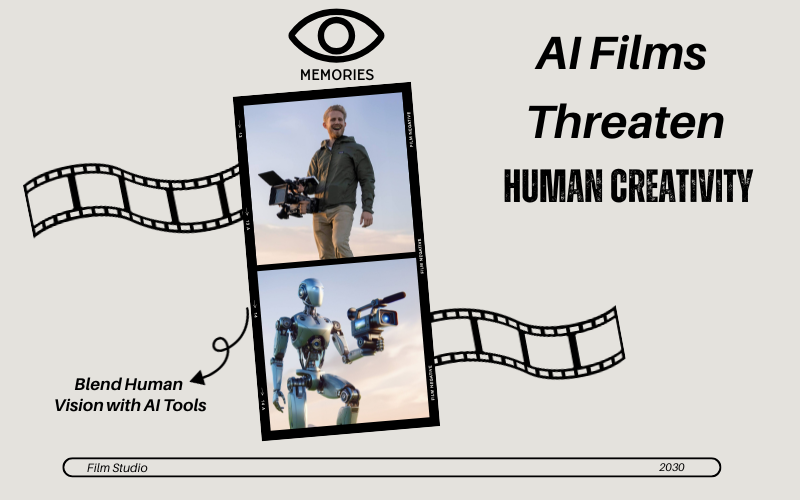
In the dynamic world of entertainment, artificial intelligence (AI) is no longer just a behind-the-scenes tool—it’s stepping into the director’s chair. From writing scripts and generating visuals to editing scenes and composing music, AI is now capable of crafting entire films. But this technological leap raises a crucial question: Are AI-generated films enhancing creativity or threatening to replace human imagination altogether?
The Emergence of AI in Filmmaking
AI has quietly been revolutionizing film production for the past decade, but 2024–2025 marks a turning point. Major platforms like Netflix, Amazon Prime, and independent creators on YouTube have experimented with AI-generated shorts, trailers, and even entire narratives. What once seemed futuristic—machines writing screenplays or creating realistic characters—is now a rapidly evolving reality.
Key technologies fueling this shift:
- Natural Language Processing (NLP): Powers AI scriptwriting (e.g., ChatGPT).
- Generative Adversarial Networks (GANs): Used for realistic visuals and face generation.
- Deep Learning Models: Enable voice synthesis and emotion replication.
- Motion Capture + AI Animation: Automates human-like performances.
What Is an AI-Generated Film, Exactly?
An AI-generated film refers to any visual narrative in which artificial intelligence plays a central role in the creative process—sometimes handling the writing, editing, animation, and even voice acting. These films can be partially AI-assisted (e.g., using AI for CGI or editing) or fully AI-created, with minimal human input.
Examples in 2025:
- “Salt” by Runway: A haunting short film created using Gen-2 video AI tools.
- “The Frost Saga” on YouTube: A fantasy story generated with AI tools for script, visuals, and voiceover.
- OpenAI’s Sora: Capable of generating full-length, photo-realistic video scenes from simple prompts.
AI Scriptwriting: Inspiration or Imitation?
One of the earliest and most debated uses of AI in filmmaking is scriptwriting. Language models like ChatGPT, Claude, and Google’s Gemini can generate screenplays in seconds. But while AI can imitate tone, style, and structure, it often struggles with nuance, emotional depth, and originality.
Pros:
- Speeds up the writing process
- Offers idea generation for writers’ block
- Supports multilingual adaptation
Cons:
- Lacks authentic emotional experiences
- Often derivative or cliché-driven
- Limited understanding of human complexity
Conclusion: AI can assist storytellers but rarely replaces the heart of human narrative.
Visuals and Animation: A New Era of Efficiency
With platforms like Runway, Pika Labs, and Sora, AI-generated visuals are becoming increasingly cinematic. Artists can now create entire scenes with just a text prompt—think “a dystopian city at night with neon lights and rain.” Within minutes, the AI can produce video content rivaling indie-level VFX.
Game Changers:
- De-aging and virtual resurrection of actors (e.g., James Dean in digital form)
- AI background generation in virtual sets
- Auto-animation tools for indie animators
Yet, this rise comes with controversy. If anyone can generate realistic footage of an actor saying or doing anything, where’s the line between art and manipulation?
AI Actors: Digital Faces with Synthetic Souls
AI-generated actors are not just possible—they’re already performing. Tools like Synthesia, Reface, and Hour One allow creators to use digital avatars or deepfakes to represent people who never existed or recreate famous actors.
Implications:
- Saves time and cost on casting and reshoots
- Allows for performances in any language without re-recording
- Can simulate long-dead actors or celebrities
However, these AI “performers” lack improvisation, spontaneity, and emotional authenticity—the hallmarks of great acting. Can an algorithm really express heartbreak, passion, or fear in a way that resonates with human audiences? Not yet.
AI in Film Music and Sound Design
AI tools like AIVA, Soundraw, and Amper can compose emotional, thematic film scores in moments. This has empowered small creators to add professional-quality music without expensive orchestras or licensing issues.
Still, many composers argue that film music is about storytelling, not just sound. While AI can mimic Hans Zimmer or Ramin Djawadi, it doesn’t understand narrative pacing or thematic development on a human level.
Is AI a Creative Tool or a Creative Threat?
AI doesn’t create art in a vacuum—it borrows patterns from millions of existing works. It “learns” from human-created art. This leads to the growing concern that AI is more imitative than imaginative.
Where AI excels:
- Speed
- Scalability
- Accessibility for amateur creators
Where AI falls short:
- Emotional authenticity
- Cultural context
- Moral storytelling
Human creativity is rooted in lived experience, cultural understanding, and emotional intelligence—things AI currently lacks.
The Risk to Human Jobs and Artistic Identity
As AI gets better, concerns grow among writers, editors, animators, and actors. In 2023, part of the Writers Guild of America (WGA) strike was driven by concerns about AI replacing screenwriters. In 2024, several voice actors reported their voices being cloned without consent.
“If AI can do everything, where do humans fit in?” – A question haunting many creatives.
The answer might lie not in replacement, but in redefinition. Just as photography didn’t kill painting—and digital didn’t kill film—AI might just be a new brush in the artist’s toolkit.
The Ethics of AI-Generated Films
AI films open a Pandora’s box of ethical issues:
- Consent: Can an actor’s likeness be used posthumously?
- Attribution: Who owns an AI-generated script—the human who prompted it or the company behind the model?
- Authenticity: Can we trust what we’re watching is real?
These questions require urgent attention, especially as deepfakes and manipulated content become more indistinguishable from reality.
Global Accessibility: A Silver Lining
Despite the debates, AI-generated content is democratizing filmmaking.
- Low-budget creators can now produce high-quality content.
- Non-English speakers can create global cinema using instant translation, dubbing, and subtitles.
- Neurodivergent and disabled artists can tell stories in new, tech-assisted ways.
This accessibility could usher in a golden age of inclusive storytelling, if used responsibly.
The Future: Collaboration, Not Competition
Rather than thinking of AI as a rival, the most productive view is to see it as a creative collaborator. Imagine:
- Human writers brainstorming with AI co-writers
- Directors using AI to visualize scenes before filming
- Editors automating rough cuts and focusing on fine-tuning emotion and pacing
In this hybrid model, humans remain the heart, while AI becomes the muscle.
Key Takeaways
- AI-generated films are here to stay, from scriptwriting to animation and voice synthesis.
- They are tools that accelerate production but struggle to replicate emotional depth and originality.
- Ethical concerns around consent, job security, and authenticity must be addressed.
- The future lies in human-AI collaboration, not full replacement.
Final Thoughts: A Question of Soul
Art has always been an expression of the soul—of pain, joy, struggle, and triumph. While AI can replicate form, can it replicate soul? That’s the defining question for the next decade of filmmaking.
The answer may not be binary. In 2025, rather than asking “Will AI replace human creativity?” perhaps the better question is:
“How can we shape AI to serve human creativity, not overshadow it?”
Because in the end, a great story isn’t just about what happens. It’s about who tells it—and why.