


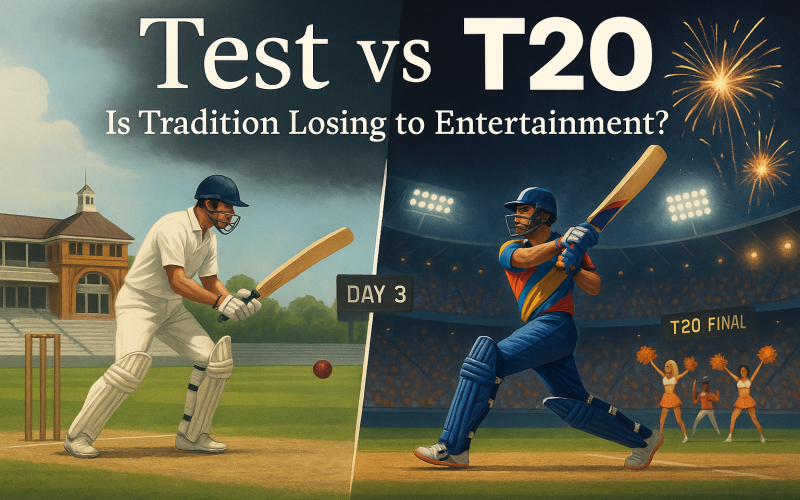
Cricket, often dubbed a gentleman’s game, has evolved dramatically over the decades. From timeless Tests that stretched over six days to the razzle-dazzle of T20 cricket packed into just three hours, the sport today exists in starkly contrasting formats. This raises a pressing question for purists and modern fans alike: Is tradition being overshadowed by entertainment? Are we watching the slow demise of Test cricket, the longest and oldest format of the game, at the hands of its fast-paced, commercially appealing cousin—T20?
A Tale of Two Formats
Test cricket, dating back to 1877, is the original and most revered format of the game. Played over five days, it demands technical mastery, tactical brilliance, patience, and grit. There are no shortcuts in Tests—victory must be earned through sustained skill and mental endurance. The format is considered the ultimate test of a cricketer’s ability.
T20, or Twenty20 cricket, emerged in the early 2000s as a response to dwindling stadium attendances and changing viewer preferences. With each side playing a maximum of 20 overs, the format was designed to deliver instant thrills, colorful uniforms, cheerleaders, music, and an electrifying experience for a new generation of fans.
The Rise of T20: Fast, Flashy, and Financially Lucrative
The launch of franchise leagues like the Indian Premier League (IPL), Big Bash League (BBL), and Caribbean Premier League (CPL) catapulted T20 cricket into the mainstream. Players became global superstars, matches were played under lights in front of packed stadiums, and TV ratings soared. Suddenly, cricket wasn’t just a sport—it was a spectacle.
For players, T20 leagues offer massive financial rewards in a condensed timeframe. Many young cricketers, especially from associate nations, find T20 the only feasible way to make a living from the game. Even established players often choose to retire from international cricket to focus on T20 leagues worldwide.
But with this rise comes an unavoidable cost.
Test Cricket: Struggling to Stay Relevant?
Despite its rich history and prestige, Test cricket faces a fight for survival. Stadiums often remain half-empty, especially outside traditional cricketing powerhouses like India, Australia, and England. Broadcasters prefer shorter formats that guarantee higher ad revenue. Even cricket boards prioritize T20 tours and leagues over long Test series.
More concerning is the attitude of players. Several top-tier cricketers are now choosing to forego Test commitments to focus solely on T20. The likes of Andre Russell, Chris Gayle, and AB de Villiers have become icons in the T20 realm, while their Test careers took a backseat or ended early.
The Intrinsic Value of Tests
Yet, ask any seasoned cricket analyst or former player, and they’ll tell you—Test cricket is where legends are truly made.
Why? Because:
- It examines every facet of a player’s skillset.
- Conditions change across five days, challenging adaptability.
- Mental fatigue sets in, requiring sustained concentration.
- Strategies unfold slowly, like a game of chess, with sessions determining the tide of the match.
Great innings like Brian Lara’s 400*, Ben Stokes’ 2019 Ashes miracle at Headingley, or the epic draw in Sydney during India’s 2021 tour of Australia—none of these moments could happen in a T20 match. These are the moments etched into the soul of cricket.
Can They Coexist?
The debate doesn’t necessarily have to pit Test and T20 as enemies. They serve different purposes, cater to different audiences, and require different skills. A well-rounded cricketer should ideally be able to adapt across formats. Players like Virat Kohli, Kane Williamson, Steve Smith, and Joe Root have shown that it’s possible to excel in both worlds.
Cricket boards and the International Cricket Council (ICC) now face the challenge of balancing tradition with entertainment. Test Championships, Day-Night Tests, and incentives for Test performances are steps in the right direction. Some suggestions to ensure the survival of Test cricket include:
- Scheduling more marquee series (e.g., The Ashes, Border-Gavaskar Trophy)
- Better marketing of Test stars
- Improving facilities and fan experience at stadiums
- Financial rewards for players choosing to commit to the format
Audience Preferences: Short Attention Spans, Big Expectations
Modern entertainment consumption is driven by speed and variety. Attention spans are shrinking, and people want action-packed experiences. T20 is tailor-made for this generation—crisp, colorful, and convenient. But it also raises a question: Should the sport compromise its depth to chase popularity?
There’s still a sizable audience that appreciates the artistry and patience of Test cricket, but they are a minority. If the current trend continues unchecked, Test cricket may slowly become a niche offering—like classical music in the age of pop hits.
Conclusion: Is Tradition Losing to Entertainment?
In some ways, yes. T20 has overtaken Test cricket in terms of popularity, money, and visibility. It appeals to a broader demographic and suits the pace of modern life. But does that mean Test cricket is dying? Not quite. It’s evolving—albeit slowly—trying to find its place in a changing world.
The cricketing ecosystem must treat all formats with respect. T20 might win the battle for attention, but Tests will always win the battle for the soul. The two can coexist, as long as fans, boards, and players recognize the unique value each format brings to the game.
Because sometimes, the slowest stories are the most unforgettable ones.