

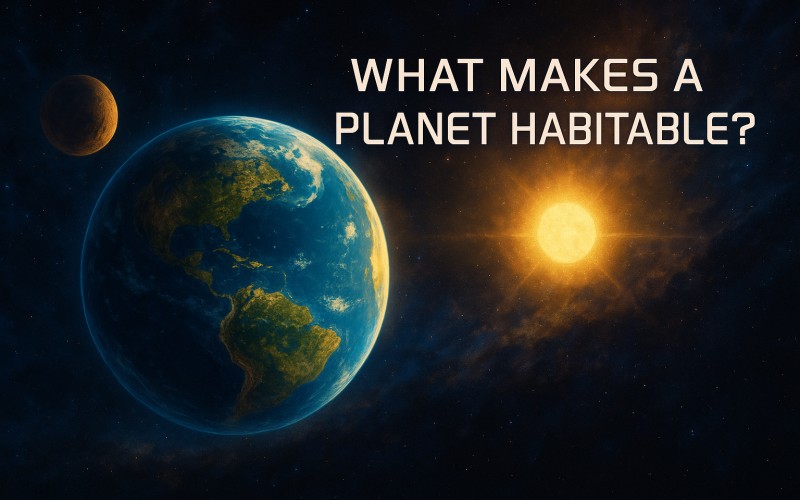
When we look up at the night sky, it’s natural to wonder: could there be another Earth out there? Astronomers are constantly searching for planets beyond our solar system, known as exoplanets, that might support life. But what exactly makes a planet “habitable”? Let’s break it down.
1. The Habitable Zone – The “Goldilocks” Distance
A planet’s distance from its star is crucial. Too close, and it’s scorched. Too far, and it’s frozen. The habitable zone is the sweet spot where liquid water can exist on the surface. Earth sits perfectly in this zone around the Sun, while Venus is too hot and Mars is just a little too cold.
2. Presence of Liquid Water
Water is often called the “universal solvent” because it plays a key role in chemical reactions necessary for life. Without stable liquid water, it’s tough for life as we know it to thrive. That’s why scientists keep searching for water signs on Mars, Europa (a moon of Jupiter), and Enceladus (a moon of Saturn).
3. Atmosphere and Air Pressure
A planet needs an atmosphere thick enough to trap heat, protect against harmful radiation, and maintain pressure so water stays liquid. Earth’s atmosphere does this perfectly, while Mars’ thin atmosphere makes it lose heat quickly and exposes its surface to radiation.
4. Magnetic Field Protection
Earth has a magnetic field generated by its molten iron core. This shield protects us from harmful solar winds and cosmic rays. Without it, a planet’s atmosphere can be stripped away over time, like what happened to Mars.
5. Stable Climate
For life to develop and evolve, a planet needs a climate that remains relatively stable over long periods. Wild fluctuations make it hard for ecosystems to survive. Earth’s tilt and rotation create seasonal cycles that balance heat and cold.
6. Chemical Ingredients for Life
Life on Earth is built on carbon, hydrogen, oxygen, nitrogen, phosphorus, and sulfur. A habitable planet needs access to these basic building blocks, either on the surface or in its atmosphere.
7. A Long-Lived, Stable Star
The star a planet orbits matters too. Stars that are too massive burn out quickly, while unstable stars emit deadly radiation bursts. A calm, long-lived star like our Sun provides a steady environment for billions of years — long enough for life to emerge.
8. Bonus Factor: Time
Habitability isn’t instant. Even with the right conditions, it takes millions — sometimes billions — of years for life to appear and evolve. A habitable planet must remain stable long enough for life to have a chance.
Final Thoughts
A habitable planet is more than just a rock in space — it’s a delicate balance of distance, atmosphere, water, protection, and time. While Earth is still the only known planet that ticks all the boxes, astronomers have already discovered several promising exoplanets in other star systems. Who knows? The next Earth-like world may already be waiting for us out there.