
How Rockets Work: The Science Behind Space Travel
Explore how rockets work and uncover the fascinating science that powers space travel and launches missions beyond Earth.
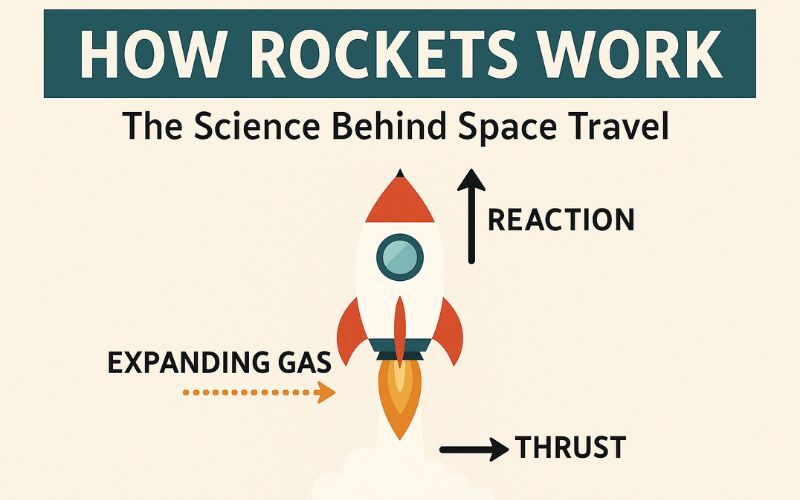
Have you ever looked up at the night sky and wondered how we send spacecraft beyond our atmosphere, all the way to the Moon or Mars? The answer lies in understanding how rockets work—an incredible fusion of science and engineering. These powerful machines are designed to overcome Earth’s gravity and explore the final frontier. But what exactly makes a rocket fly? Let's break down the science behind space travel.
The Basic Principle: Newton's Third Law
At the heart of rocket science is Newton’s Third Law of Motion: For every action, there is an equal and opposite reaction. This may sound like textbook jargon, but it’s the foundation of how rockets work. When a rocket engine burns fuel, it expels exhaust gases out of the nozzle at high speed. This creates an "action." The "reaction" is the rocket being pushed in the opposite direction — upward into the sky. Think of it like letting go of a blown-up balloon without tying it; the air rushes out, and the balloon zips away in the opposite direction. This law allows rockets to work even in space, where there's no air. Unlike jet engines, which need oxygen from the atmosphere, rockets carry their own oxygen onboard to burn fuel. That’s why they’re ideal for space missions.Rocket Structure: Key Parts
To understand how rockets fly, it helps to look at their major components:1. Propulsion System (Engines + Fuel)
The propulsion system includes rocket engines and fuel tanks. The engine burns fuel (often liquid hydrogen or kerosene) and an oxidizer (like liquid oxygen) to produce hot gases. These gases shoot out of the nozzle at tremendous speeds, pushing the rocket upward.2. Payload
This is the rocket's "cargo." It could be a satellite, a space probe, or a crew capsule. For example, NASA’s Artemis missions carry astronauts, while SpaceX rockets often transport supplies to the International Space Station.3. Guidance System
To hit its target in space, a rocket needs to be smart. The guidance system includes computers, sensors, and software that steer the rocket, adjust its angle, and keep it on course.4. Structure (Airframe)
This is the frame that holds everything together. It needs to be strong enough to withstand launch forces but light enough not to weigh the rocket down.Stages of Rocket Launch
Most space rockets are multi-stage rockets, meaning they are built in sections that fall away during the flight. Why? Because carrying used-up fuel tanks is dead weight. Here's how it works:- Stage 1: The biggest engines fire first, lifting the rocket off the ground and through the thickest part of Earth’s atmosphere.
- Stage 2 and beyond: After the first stage is empty, it detaches. The next stage ignites and continues the journey.
- Final stage: This carries the payload into orbit or on a path to the Moon, Mars, or beyond.
Overcoming Gravity and Atmosphere
To reach space, a rocket must escape Earth’s gravity and punch through the atmosphere. Earth’s gravity pulls everything downward with great force. A rocket needs to reach a speed of about 11.2 kilometers per second (25,000 mph) — called escape velocity — to break free. During launch, rockets face air resistance, wind, and pressure changes. That’s why the engines have to produce millions of pounds of thrust, which is the force pushing against gravity and drag.Types of Rocket Fuels
Rocket fuel is not your average gasoline. There are two main types:1. Liquid Propellants
Used in most modern rockets like the Saturn V and Falcon 9, this system mixes liquid fuel and oxidizer. It offers precise control — you can throttle the engine or even shut it off mid-flight.2. Solid Propellants
Used in earlier missions and boosters (like the space shuttle’s side rockets), these are simpler and reliable. Once ignited, they burn until the fuel is gone. Some newer concepts explore ion propulsion, nuclear rockets, and electric thrusters, but those are more common in deep space missions, not launches from Earth.SpaceX, NASA, and the Future of Rockets
In the past, rockets were almost entirely run by government space agencies like NASA. Today, private companies such as SpaceX, Blue Origin, and Rocket Lab are revolutionizing space travel. One big innovation is reusable rockets. Traditionally, rocket stages were discarded into the ocean or burned up in the atmosphere. SpaceX's Falcon 9 changes that — its first stage lands back on Earth and can be used again, dramatically lowering the cost of space missions. NASA’s new Space Launch System (SLS) and SpaceX’s upcoming Starship are pushing the boundaries further, aiming for Moon bases and Mars colonization.Fun Facts About Rockets
- The Saturn V, which took astronauts to the Moon, was 363 feet tall — taller than a 30-story building.
- Rockets are loud! The noise at liftoff can reach 180 decibels, enough to shatter glass.
- A rocket launch burns tons of fuel per second. The Saturn V’s first stage used about 12 tons every second.
Conclusion: Why Rockets Matter
Rockets are more than just fiery machines — they are the vehicles of human dreams. They carry satellites that power GPS, weather forecasts, and communication. They send probes to other planets and help us learn about the origins of the universe. And perhaps most exciting, they are paving the way for future generations to live and work in space.

Comments
Leave a comment Replying to
Comments are reviewed before they appear. Your email is never published.