

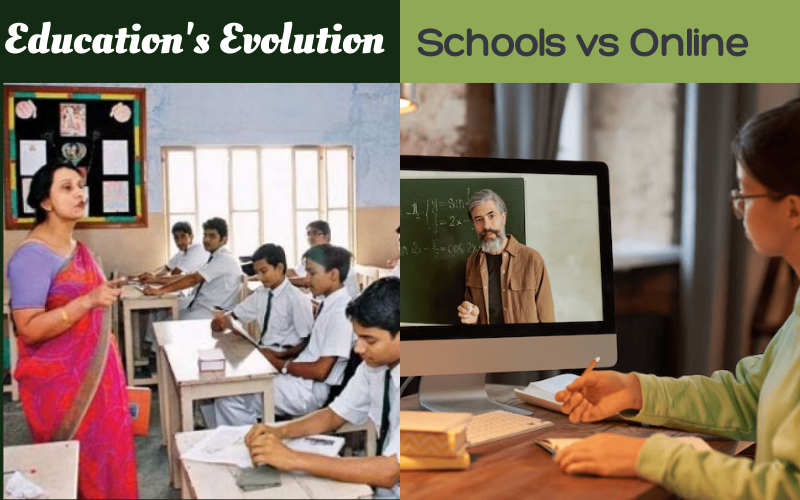
The education system has always been a reflection of society’s values, needs, and technological advancements. In recent decades, however, education has been undergoing a dramatic transformation. The rise of the internet, digital tools, and most notably, online learning platforms, has begun to challenge the dominance of traditional schools. The COVID-19 pandemic only accelerated this shift, forcing millions of students and teachers to embrace remote education overnight.
As we look toward the future, an important question arises: Will traditional schools remain central to education, or will online learning become the new norm? This blog explores the strengths, limitations, and future prospects of both traditional schools and online learning, and considers whether a hybrid model might be the key to evolving education for the 21st century.
Traditional Schools: The Classic Education Model
- Structure and Discipline
Traditional schools provide structure—set schedules, curriculums, physical classrooms, and face-to-face instruction. This organization benefits students who thrive in a routine and who require direct guidance and interaction.
- Fixed timetable: Helps students develop time management and accountability.
- In-person teacher support: Facilitates immediate feedback and one-on-one help.
- Social development: Encourages teamwork, emotional intelligence, and conflict resolution.
- Extracurricular Activities and Holistic Growth
Schools are not just about academics. They offer sports, drama, music, debates, clubs, and social events that play a significant role in holistic development.
- Soft skills: Leadership, public speaking, collaboration.
- Physical activity: Crucial for growing minds and bodies.
- Creativity: Arts and crafts, science fairs, and exhibitions cultivate innovation.
- Classroom Learning and Peer Interaction
Face-to-face interaction fosters a sense of community and connection. This helps students develop friendships, experience competition, and learn interpersonal skills in real time.
- Peer learning: Group projects and discussions enhance critical thinking.
- Teacher-student bonds: Emotional connections often inspire better learning.
- Real-time collaboration: Immediate idea exchange and feedback.
Online Learning: The Digital Revolution
- Flexibility and Accessibility
One of online learning’s biggest advantages is that it breaks down geographical and time constraints. A student in a rural town can now access the same course as someone in a major city.
- Anytime, anywhere: Learn at your own pace and convenience.
- Cost-effective: Reduces transportation, housing, and material expenses.
- Global reach: Access to top universities and experts worldwide.
- Personalization and Adaptive Learning
AI-powered platforms like Coursera, Khan Academy, and Byju’s adjust content based on the learner’s strengths and weaknesses.
- Customized learning paths: Tailored assignments and quizzes.
- Progress tracking: Analytics help learners and instructors monitor development.
- Multiple learning formats: Videos, podcasts, interactive games, and texts suit various learning styles.
- Technological Integration
The integration of augmented reality (AR), virtual reality (VR), and gamification has made online learning more engaging and immersive.
- Virtual labs: Enable science experiments without a physical lab.
- Simulations: History, medicine, or engineering concepts brought to life.
- Gamified learning: Makes studying enjoyable and competitive.
Traditional vs Online: A Comparative Overview
| Criteria | Traditional Schools | Online Learning |
| Flexibility | Fixed schedules | Learn anytime, anywhere |
| Cost | Higher (fees, transport, materials) | Lower (subscription or one-time fees) |
| Social Interaction | High (peers, teachers) | Low to moderate (forums, video calls) |
| Access | Limited to local or regional schools | Global access |
| Learning Style | One-size-fits-all approach | Personalized and self-paced |
| Technology Dependence | Minimal | High |
| Extracurriculars | Sports, clubs, events | Limited or simulated |
| Discipline | External (teachers, rules) | Internal (self-motivation needed) |
Challenges in Both Models
Traditional School Challenges:
- Overcrowded classrooms
- Rigid curriculums
- Lack of customization
- Teacher burnout
- Accessibility issues in rural or underprivileged areas
Online Learning Challenges:
- Digital divide (lack of internet or devices)
- Motivation and discipline problems
- Screen fatigue
- Limited real-world interaction
- Accreditation and quality concerns
The Pandemic Push: A Turning Point in Education
The COVID-19 pandemic created the world’s largest education disruption in modern history. With over 1.6 billion students affected globally, institutions had to shift to remote learning practically overnight. This forced adoption showed us what online learning could do — and where it still falls short.
Positive Outcomes:
- Increased awareness of online platforms.
- Upskilling of teachers in digital tools.
- Boost in EdTech startups and innovation.
Challenges Exposed:
- Inadequate preparedness.
- Inequality in digital access.
- Emotional disconnect among students.
The Future: Blended Learning and Hybrid Models
Rather than viewing traditional and online learning as competitors, the future of education likely lies in combining the best of both worlds.
- Blended Classrooms
In this model, students attend physical schools but supplement their education with online tools and resources.
- Flipped Classrooms: Students learn content online at home and do “homework” (discussions, problem-solving) in class.
- Teacher as facilitator: Focus shifts from lecture to mentoring and guiding.
- AI and Data-Driven Education
Future classrooms, whether online or offline, will be powered by AI that personalizes learning for every student.
- Real-time feedback: Data analytics to spot learning gaps early.
- Predictive performance models: Identify at-risk students before they fall behind.
- Microlearning and Modular Education
Students may no longer follow rigid syllabi but instead learn in micro-units that are stackable.
- Skill-focused: Learn exactly what’s needed for a specific goal or job.
- Credentialing: Badges, certificates, and modular degrees.
- Global Classrooms
Language translation, VR, and collaborative platforms will allow students from different parts of the world to study together.
- Cross-cultural learning: Develops empathy and global awareness.
- Shared resources: Access to global faculty and libraries.
Implications for Society
Teachers
Will evolve into coaches, content curators, and facilitators. Their role will shift from delivering knowledge to mentoring and problem-solving.
Parents
Will play a more active role, especially in online or hybrid education. Their involvement in structuring home environments will be crucial.
Students
Will need to develop skills like self-regulation, time management, and digital literacy to thrive in flexible learning environments.
Governments and Policymakers
Must ensure:
- Digital access for all.
- Teacher training programs.
- Regulation and quality control of EdTech platforms.
- Mental health support systems for remote learners.
Beyond Academics: Mental and Emotional Health
Both traditional and online systems must acknowledge the growing importance of mental health, emotional intelligence, and life skills. Future education must be holistic — helping students navigate not just exams, but life.
- Mindfulness in education
- Peer support programs
- Counseling access (in-person and virtual)
Conclusion: What Will Define the Future?
The future of education will not be a battle of traditional vs. online learning. It will be adaptive, inclusive, and hybrid. We will see an ecosystem where:
- Students learn in ways that suit them best.
- Schools evolve into dynamic, technology-powered hubs.
- Online platforms become sophisticated learning partners.
Education must grow beyond buildings and screens. It must reach minds — wherever they are. The real goal should not be choosing between traditional and online but designing learning systems that are personalized, equitable, and future-ready.
As we move into this new era, collaboration among educators, technologists, students, and parents will be the cornerstone of success. And perhaps for the first time in history, education can truly become a universal right — not just in principle, but in practice.