


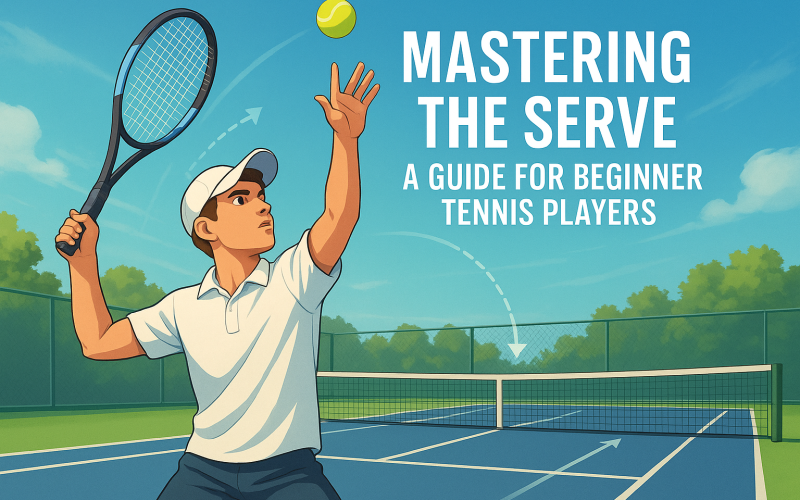
Mastering the Serve is essential for any tennis player. The serve is the most crucial shot in tennis—it starts every point, sets the rhythm of the game, and can even decide the outcome of a match. For beginners, the serve may seem intimidating—there’s a lot to coordinate, and many moving parts. But once mastered, it becomes a powerful weapon. Whether you’re playing for fun or aiming to compete, learning how to serve correctly can elevate your game.
In this guide, we’ll break down the serve into easy steps, explain common mistakes, and provide tips to help beginners build a strong foundation.
Why the Serve Matters
The serve isn’t just a way to start a point — it’s a strategic shot. A good serve can:
- Put your opponent on the defensive
- Earn you free points with aces
- Set you up for easy winners
- Control the pace of the game
Unlike other shots, the serve is the only time you have complete control of the ball without interference. This makes it an ideal shot to master early in your tennis journey.
The Fundamentals of a Good Serve
Let’s break down the serve into its core components:
- Grip
For beginners, the continental grip is best. It allows for flexibility, control, and spin. Think of it like holding a hammer — your index knuckle should be on the second bevel of the racket handle.
- Stance and Positioning
- Stand behind the baseline, slightly sideways.
- Your front foot (left for right-handed players) should point toward the net post.
- The back foot should be parallel to the baseline.
- Keep your feet shoulder-width apart and maintain balance.
- Ball Toss
The toss is one of the most important parts — and often one of the hardest.
- Hold the ball lightly with your fingertips, not your palm.
- Toss it straight up (not backward or forward), about 1–2 feet above your outstretched racket.
- It should land slightly in front of your body, around 12 o’clock position (for flat serves).
- Swing Mechanics
- As you toss, bring your racket back in a “trophy position” — elbow bent, racket head behind your head.
- Your non-dominant arm should point up for balance and alignment.
- As the ball reaches peak height, rotate your shoulders and bring your racket forward in a whipping motion.
- Snap your wrist at contact and follow through across your body.
- Footwork and Motion
Beginners can start with a “platform stance” (feet fixed), which is easier for balance. Later, you can progress to a “pinpoint stance” where your back foot joins your front foot before the jump.
Common Beginner Mistakes (and How to Fix Them)
- Tossing the Ball Too Low
- Fix: Practice tossing to a consistent height. Use a wall to mark the ideal toss level.
- Hitting the Ball Too Late
- Fix: Focus on timing. Make contact when the ball is at its peak or just starting to descend.
- Using Only the Arm
- Fix: Involve your whole body — hips, shoulders, and legs. Power comes from coordination, not just strength.
- No Follow-Through
- Fix: Always complete your motion. A full follow-through helps with control and spin.
- Holding the Racket Too Tight
- Fix: Keep a relaxed grip to allow wrist flexibility. Tension kills control.
Mental Tips for Serving
- Visualize the serve before hitting — target, height, spin.
- Stay calm under pressure — rushing leads to errors.
- Focus on rhythm — consistency beats speed when starting out.
- Don’t fear double faults — they’re a part of learning.
Types of Serves to Try (as You Improve)
As you gain confidence, experiment with different types of serves:
- Flat Serve
- Fast, powerful, minimal spin.
- Best for aces and aggressive first serves.
- Topspin Serve
- Generates heavy bounce, safer over the net.
- Great for second serves.
- Slice Serve
- Curves sideways, pulling opponents off the court.
- Useful for both first and second serves.
Focus on developing one type first — preferably the topspin or flat serve — and gradually add variety.
Drills to Practice Your Serve
Toss Practice
- Stand without a racket and practice 20 consistent tosses.
- Mark a spot on the ground where the toss should land.
Shadow Serving
- Practice serve motion without the ball to perfect technique.
- Focus on smoothness and balance.
Target Serving
- Place cones or water bottles on the opposite service box.
- Try to hit them with your serve — build both accuracy and control.
Racket Drop Drill
- Stop at the trophy position, drop the racket, and freeze.
- This builds muscle memory for proper shoulder and elbow rotation.
Serve Routine: Build a Ritual
Watch pro players — almost all have a serve routine. Bouncing the ball, adjusting grip, breathing — these actions calm the nerves and help with focus. Create your own short routine and repeat it before every serve.
Final Thoughts: Serve Like a Pro
Mastering the serve takes time and practice — but it’s completely achievable, even as a beginner. Start slow, focus on technique over power, and be patient with yourself. Film your serve to watch your form, or ask a coach for feedback. The serve is a journey, and every great server started exactly where you are now.
Before long, you won’t just be putting the ball in play — you’ll be winning points right from your hand.