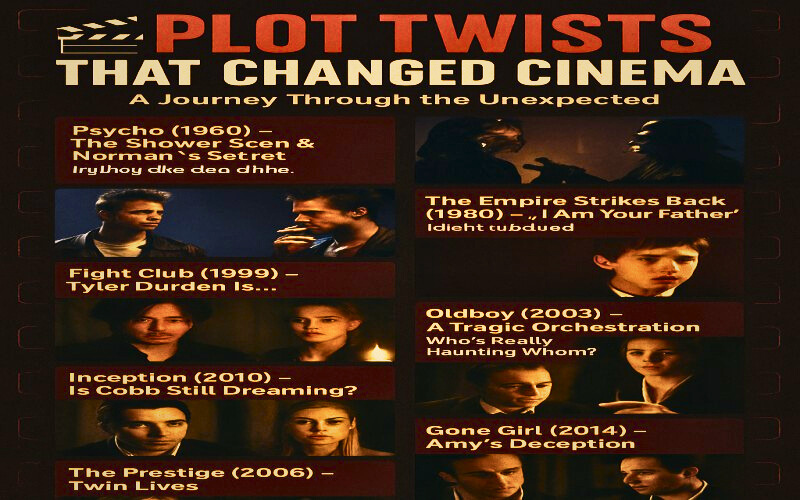
Plot Twists That Changed Cinema: A Journey Unexpected

Plot Twists That Changed Cinema

In the world of cinema, few things captivate audiences more than a well-executed plot twist. That moment when everything you thought you knew is suddenly turned on its head — it’s shocking, thrilling, and often unforgettable. Plot twists are more than just narrative gimmicks; when done right, they redefine stories, characters, and even entire genres.  From classic thrillers to mind-bending science fiction, let’s dive into the most iconic plot twists that not only stunned audiences but also changed the very fabric of cinema. 


  1. Psycho (1960) – The Shower Scene & Norman’s Secret

Director: Alfred Hitchcock 

 Why It Changed Cinema: 

 Alfred Hitchcock’s Psycho is legendary not just for its horror, but for breaking all the storytelling rules. Early in the film, the audience is led to believe that Marion Crane (played by Janet Leigh) is the main character. But just 45 minutes in, she’s brutally murdered in the infamous shower scene — a cinematic shocker. 

Then comes the twist: Norman Bates isn’t just a shy motel owner; he’s been impersonating his dead mother, who we think is alive until the end. This plot twist redefined horror and psychological thrillers, setting the blueprint for modern suspense storytelling. 


  1. The Empire Strikes Back (1980) – “I Am Your Father”

Director: Irvin Kershner 

 Why It Changed Cinema: 

 In the climactic lightsaber duel, Darth Vader delivers cinema’s most quoted line: “No, I am your father.” This twist wasn’t just shocking — it redefined the entire Star Wars narrative and changed how audiences perceived villains. 

For decades, villains had been purely evil; this twist gave Vader emotional depth and set a new standard for morally complex characters in fantasy and sci-fi films. 


  1. Fight Club (1999) – Tyler Durden Is…

Director: David Fincher 

 Why It Changed Cinema: 

 Based on Chuck Palahniuk’s novel, Fight Club is a deep exploration of masculinity, consumerism, and identity. The major twist — that Tyler Durden (Brad Pitt) is just a figment of the unnamed narrator’s (Edward Norton) imagination — challenges the viewer’s understanding of the story they’ve just watched. 

This twist introduced a new era of psychological thrillers where unreliable narrators became central to the experience. It’s a film that demands multiple viewings and rewards the observant. 


  1. The Sixth Sense (1999) – “I See Dead People”

Director: M. Night Shyamalan 

 Why It Changed Cinema: 

 If there’s one twist that became the gold standard for its time, it’s the revelation that Dr. Malcolm Crowe (Bruce Willis) has been dead the entire time. 

What makes The Sixth Sense remarkable is not just the twist itself, but how subtly it’s set up. The clues are there throughout, but Shyamalan masterfully misdirects the audience until the end. After its release, nearly every thriller was marketed with the promise of “a twist you won’t see coming,” creating a cultural shift in how stories were told and sold. 


  1. Oldboy (2003) – A Tragic Orchestration

Director: Park Chan-wook 

 Why It Changed Cinema: 

 This South Korean neo-noir thriller is renowned for its brutal violence, complex narrative, and a jaw-dropping twist that redefines the word “revenge.” When Oh Dae-su is finally released from 15 years of imprisonment, he embarks on a mission to find out why. 

The twist? He was manipulated into a sexual relationship with his own daughter as part of a meticulously planned revenge scheme. Dark, disturbing, and profoundly emotional, Oldboy shattered taboos and redefined how far a twist could go in altering audience perception. 


  1. The Others (2001) – Who’s Really Haunting Whom?

Director: Alejandro Amenábar 

 Why It Changed Cinema: 

 In this gothic horror masterpiece, Grace (Nicole Kidman) believes her house is haunted. As the film builds with tension and suspense, the audience is led to believe that the spirits are threatening her children. 

But the twist flips everything — Grace and her children are the ghosts. The “others” in their house are the living. This reversal turns a traditional haunted house story into a poignant tragedy about denial, death, and acceptance. 


  1. Inception (2010) – Is Cobb Still Dreaming?

Director: Christopher Nolan 

 Why It Changed Cinema: 

 While not a single “gotcha” twist, Inception weaves its entire narrative around shifting realities. The film’s final scene — the spinning top — sparked debates worldwide: Did Cobb (Leonardo DiCaprio) make it back to reality, or is he still dreaming? 

Nolan doesn’t give a concrete answer, and that ambiguity became part of the film’s genius. It showed that modern audiences could handle complex, layered storytelling — and crave it. 


  1. The Prestige (2006) – Twin Lives

Director: Christopher Nolan 

 Why It Changed Cinema: 

 This twist-laden film pits two rival magicians against each other in a game of deception and sacrifice. The final reveal — that Borden (Christian Bale) is actually two men (twins living a shared life) — is both shocking and deeply tragic. 

It also raises questions about obsession, identity, and the cost of greatness. The Prestige’s twist isn’t just for shock; it enhances the film’s central theme of “devotion to the trick.” 


  1. Gone Girl (2014) – Amy’s Deception

Director: David Fincher 

 Why It Changed Cinema: 

 What starts as a classic whodunit — a missing wife and a suspicious husband — quickly becomes a commentary on media, marriage, and manipulation. The twist: Amy (Rosamund Pike) faked her own disappearance to frame her husband. 

The mid-movie reveal transforms the narrative and gives control to a terrifyingly intelligent antagonist. Gone Girl reinvigorated the thriller genre with its layered perspectives and subversion of gender roles. 


  1. The Usual Suspects (1995) – “The Greatest Trick…”

Director: Bryan Singer 

 Why It Changed Cinema: 

 The entire movie is a story told by Verbal Kint (Kevin Spacey), a seemingly nervous man being interrogated about a crime. At the end, we discover that he is none other than Keyser Söze, the mythical crime lord he claimed was behind everything. 

This twist not only redefines the entire narrative but also questions the very act of storytelling in film. Who’s the narrator, and can we trust them? 


Why Plot Twists Matter 

Plot twists are more than surprise endings. They force audiences to re-evaluate everything they’ve just seen, challenging perceptions and assumptions. But great twists aren’t just “shock value.” They: 

  • Serve the story rather than hijack it. 
  • Enhance rewatch value — viewers return to catch clues they missed. 
  • Elevate themes — many twists aren’t just narrative shifts, but thematic revelations. 


The Psychology Behind Plot Twists 

Why do we love plot twists? 

  1. Cognitive Dissonance – Our brains love patterns. Twists break them, creating a jolt of realization. 
  1. Emotional Reward – A good twist feels like solving a puzzle; it’s intellectually satisfying. 
  1. Heightened Engagement – When we suspect a twist is coming, we become hyper-aware, boosting engagement. 

Directors and writers use these psychological triggers to their advantage — hiding clues in plain sight, creating red herrings, and rewarding the attentive viewer. 


Honorable Mentions 

  • Primal Fear (1996): The “split personality” twist that launched Edward Norton’s career. 
  • Arrival (2016): A time-loop twist that turned a sci-fi alien movie into a meditation on grief. 
  • Shutter Island (2010): Leonardo DiCaprio’s character is not a detective — he’s the patient. 
  • The Village (2004): The seemingly ancient village is in fact a modern-day isolationist society. 


Conclusion: When Twists Work, They Become Timeless 

Plot twists are the heartbeat of many unforgettable films. They reward attention, spark discussion, and stay with us long after the credits roll. But the best ones don’t just surprise — they illuminate. They take a good story and make it great. 

As audiences grow more sophisticated, filmmakers continue pushing the boundaries of narrative structure. Twists may evolve, but their power — to shock, move, and transform — remains timeless. 

So next time a movie flips your expectations, don’t just be surprised. Ask yourself why it worked. That’s where the real magic lies. 


Total
0
Shares
Leave a Reply

Your email address will not be published. Required fields are marked *

Related Posts