
What are Digital Twins and Why Industries Are Obsessed
Discover what are digital twins are and why industries are obsessed with using them for innovation, efficiency, and decision-making.
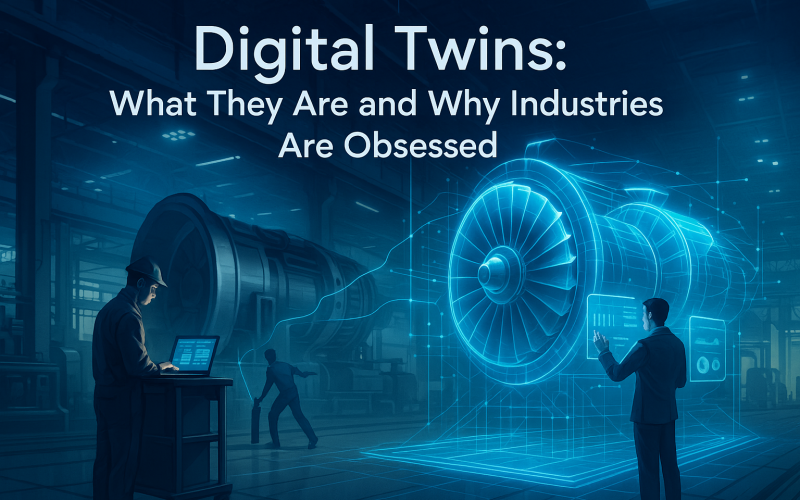
In the rapidly evolving world of technology, few innovations have generated as much excitement — and strategic investment — as digital twins. The concept may sound futuristic, but it's already reshaping industries from healthcare to aerospace, smart cities to manufacturing. Digital twins are not just a tech buzzword — they are a revolutionary way of simulating, monitoring, and optimizing real-world systems using digital technology.
So, what exactly is a digital twin, and why are so many industries obsessed with it?
What Is a Digital Twin?
A digital twin is a virtual representation of a physical object, system, or process. It mirrors the real-world counterpart in real-time using data from sensors, AI, and machine learning. This allows businesses to simulate scenarios, predict failures, test performance, and gain deep insights — all without touching the real thing. Think of it as a living, learning digital clone. For example:- In manufacturing, a digital twin of a machine can predict when it will break down.
- In healthcare, a digital model of a heart could help simulate the impact of different treatments.
- In urban planning, a smart city can be digitally recreated to test traffic or pollution strategies.
A Brief History of Digital Twins
Though the term "digital twin" was popularized by NASA in the early 2000s (used to monitor and simulate space capsules), the core idea dates back even further to the Apollo 13 mission, where engineers used a physical replica to solve problems remotely. Today, thanks to the explosion of IoT (Internet of Things) devices, faster computing power, and big data analytics, digital twins are more accessible and more powerful than ever before.Why Are Industries Obsessed?
The obsession with this isn't just hype — it’s rooted in real business value:- Predictive Maintenance & Cost Savings
- Design Optimization
- Real-Time Monitoring
- Sustainability & Efficiency
- Customization & Personalization
🏙️ Use Cases Across Industries
Let’s look at how digital twins are being used in real-world sectors:Automotive
Companies like BMW and Tesla use digital twins for vehicle design, crash testing simulations, and remote diagnostics. They can tweak designs virtually before manufacturing a single component.Manufacturing
Digital twins of entire factories help managers optimize production lines, test new workflows, and monitor the health of machines 24/7.Aerospace
Airbus and Boeing use digital twins to monitor aircraft in real time, enhance safety, and manage maintenance schedules efficiently.Healthcare
Imagine a digital twin of a patient’s organs that allows doctors to simulate how a drug will behave — before it's even prescribed. It’s already happening in clinical trials and cardiac care.Smart Cities
Urban planners are building digital twins of entire cities (like Singapore) to simulate traffic, pollution, construction, and emergency response — making cities smarter and more livable.Real Estate & Architecture
Digital twins of buildings help architects and facility managers simulate energy usage, airflow, lighting, and more, leading to smart, adaptive spaces.Challenges and Concerns
As with any technology, digital twins come with challenges:- Data Privacy & Security: When real-time data is constantly flowing, keeping it secure is critical, especially in sensitive sectors like healthcare or defense.
- Cost of Implementation: Building and maintaining digital twins — especially at scale — can be expensive.
- Data Accuracy: A digital twin is only as good as the data it receives. Poor sensor quality or delayed data can lead to wrong decisions.
- Complexity: Creating a true-to-life twin of a complex system requires deep integration between hardware, software, and human expertise.
The Future
The future of digital twins is deeply intertwined with AI, edge computing, and 5G. As AI becomes more sophisticated, digital twins will not only mirror reality but also autonomously optimize it. Imagine:- Autonomous factories that self-correct using AI-driven digital twins.
- Healthcare systems that simulate disease outbreaks in real-time.
- Metaverse integrations, where you can walk through your digital twin smart home virtually before it's built.
Conclusion: Not Just a Trend — A Transformation
They are no longer the future — they are here, quietly transforming industries and reshaping the way we think about the physical world. With their ability to simulate, predict, and optimize, they offer unparalleled value across sectors. From saving millions in downtime to designing smarter products and enabling personalized medicine, It represent a fundamental shift in how humans and machines interact. Industries aren’t just obsessed — they’re betting big. And it’s a bet that’s already paying off.
Comments
Leave a comment Replying to
Comments are reviewed before they appear. Your email is never published.